
Cube First Impressions: TMNT

Before the Lorwyn Eclipsed prerelease, I finished my cube review of Lorwyn Eclipse; over that weekend, the Teenage Mutant Ninja Turtles rares were accidentally included in the prerelease packs, which led to Wizards officially previewing the rares and mythics from the set.
The day before that drop happened, I talked about how with early leaks, there haven’t been a lot of taking advantage of that lead time for evaluating cards, as card evaluation tends to happen in a “set it and forget it” way to not think about cards after an initial view of the card, with many people (myself included) seeing Settle the Wreckage in an early leak of an Ixalan foil sheet and dismissing it as a bad wrath that gives the opponent’s lands, only to find out when the cards were played with, on paper, that the evaluations on that card were wrong.
Having seen this happen many times (New Phyrexia had a lot of design mistakes that weren’t truly realized until the set got into players’ hands) and out of not wanting to waste that lead time, I figured that I’d give my first impressions of the TMNT set’s rares and mythics shown, using this as a thought experiment for seeing how my thoughts change over time, with more concrete impressions cemented when I write my cube review when the set drops, via testing cards out with reps in my own cube. Being able to cube on a regular basis is a luxury that not everyone has (it’s something I myself didn’t for many years, and I’ve never forgotten that,) and is something I’m grateful for, even if drafts don’t always happen as planned.
As usual, I focus more on ‘high power’ cubes than thematic ones, using a more high-powered, generalist perspective for cube card evaluation, allowing designers to adjust as needed for their specific environments.
White:
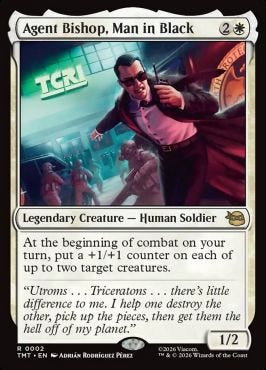
Agent Bishop, Man in Black:
I’ve heard good things about this and I recently had it in a (trainwreck RW aggro) draft deck where it felt like my worst 3-drop. Essentially, this is what you’d get if Ouroboroid and Luminarch Aspirant had a baby, and it’s nice that this can attack as a ¾ if it puts counters on itself for its first few triggers. It’s also nice with Valiant cards like Heartfire Hero and Emberheart Challenger since they care about being targeted, but I’m unsure how much of the puzzle that’ll be to make this good; white 3s already have a bevy of all-stars and this mostly looks like another one.
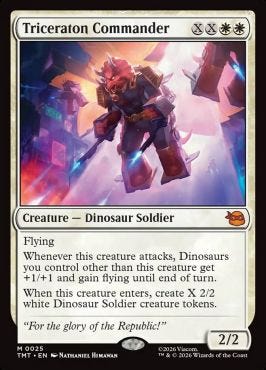
Triceraton Commander:
2025 brought a ton of great 2-drops for cubes, and in the grand scheme of things, this is yet another one of them, although its floor of being a 2-power flier for 2 is not too special by recent creature standards, but it at least scales to the later stages of the game in a more direct manner (Luminarch Aspirant takes some time to build a board, etc.)
I’m going to assume that the attack trigger helps its other tokens, since ECL/ECC didn’t give us much in terms of powerful changelings.
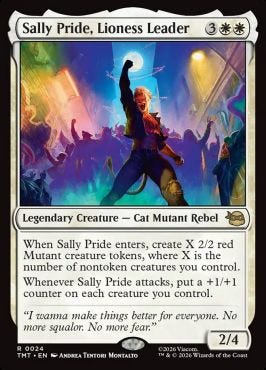
Sally Pride, Lioness Leader:
Casting this on an empty board only for this to meet a Doom Blade has to be the worst feeling in the world, but it can… theoretically make a bunch of creatures that turn into 3/3s if this survives to attack. I’m unsure where the acceptable floor is for this, but I have a feeling that having 2 other creatures is when you start to get happy with casting it, since attacking with it and friends is 9 power on top of what else there is.
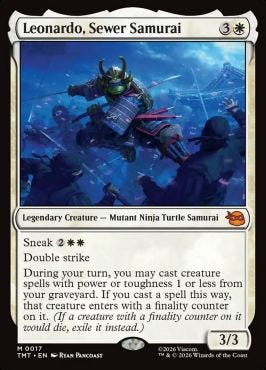
Leonardo, Silver Samurai:
As one of the early previews, I’ve been able to give this a whirl for a few drafts and it’s been pretty good as a source of burst damage that kinda meets Lurrus, although it’s obviously much more restrictive. Being able to recur things with power or toughness helps a lot for finding things to recur, and there’s some nice ones to grind: Thraben/Novice Inspector, Thundertrap Trainer, Snapcaster Mage, Eternal Witness and friends.

Turtles Forever:
It isn’t terribly difficult to end up with a lot of legendary creatures in the final 45 of a cube deck, since a lot of good creatures (including in this set) are legendary, and there’s ways to explicitly support that with cards like Yoshimaru and Flowering of the White Tree. The use of sideboards is generally an unexplored space in cube design, at least explicitly using it for things like this and North Wind Avatar.
I haven’t felt too impressed with it so far, but as a 4-mana card that lets you get 2 real creatures (assuming you can cast them, which rainbow sources and triomes can help with) at instant speed has potential. It just hasn’t lived up to that yet.
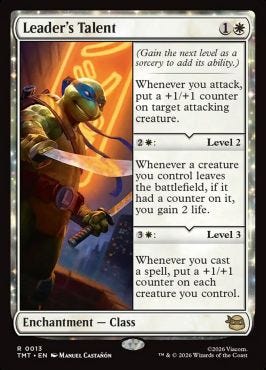
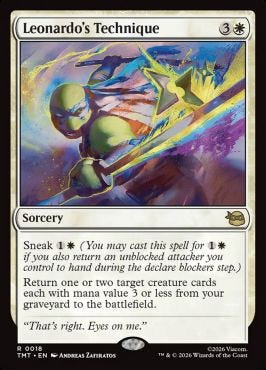
Leader’s Talent and Leonardo’s Technique:
Both of these seem like middling riffs on cards that already exist, like Leader’s Talent being a riff on Innkeeper’s Talent with some hoops to jump through and a pretty bad middle ability. The last chapter has potential but having to spend 2W to get to the pretty mediocre 2nd level and 3W for the last level is rough.
Blue:
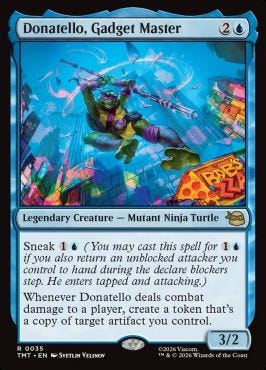
Donatello, Gadget Master:
This is one of the ninjas that I liked from the set, as it’s easy to sneak into play with 1-drop and its copy trigger can be useful, even in the early game with cheap artifacts and baubles out there to copy with this. We had an undefeated deck, which had this copy a Spellskite amongst other things. It can copy cheap mana rocks in cubes that have them, but I’m unsure if something like this would copy a mox and then never do anything again. It at least has 3 power though.
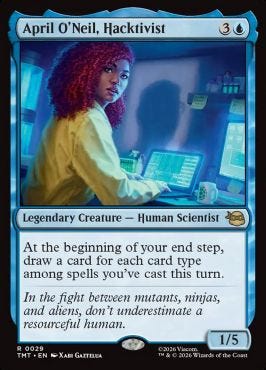
April O’ Neil, Hacktivist:
For a 5-drop that doesn’t give guaranteed value since it can just die before the end step, it’s had some decent first impressions so far, where it usually drew a couple of cards a turn without much effort on the turn of being cast, and then usually more cards after. She felt, in a way, like a planeswalker as something that could sustain value over a game, although more vulnerable.
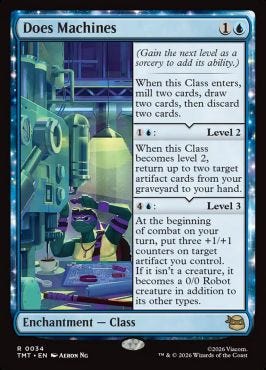
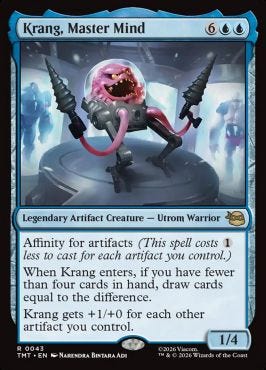
Does Machines and Krang, Master Mind:
Both of these are obvious artifact cards that reward playing through things on the cheap. Does Machines’ second chapter is pretty decent if you have baubles etc to bring back, since it can emulate drawing 4 + discard 2 for 4. I just don’t know if that juice is worth the squeeze when cubes have options like Stock Up, Consult and Brainsurge, although that way of thinking about things led to many dismissing Stock Up (myself included.)
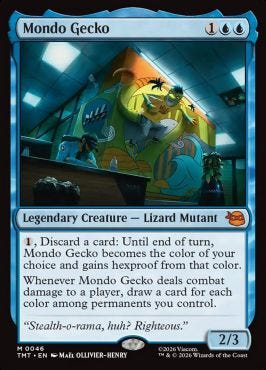
Mondo Gecko:
I mostly looked at this like an odd Psychic Frog that can protect itself, but can’t sneak by things. This may just be more of a 4-mana play, like how Aetherling was more of a 7-mana play, which gives me some pause, but if this ever draws 2 cards, it’s likely worth that main phase mana investment.
Black:
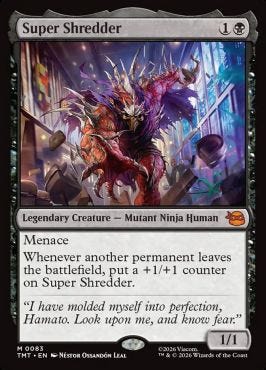
Super Shredder:
This occupies a space similar to cards like Moonshadow, although even though it wasn’t an early preview, I’ve not seen it do much. Its ceiling is pretty amazing, since it only takes a couple of permanents to get it to be efficient.
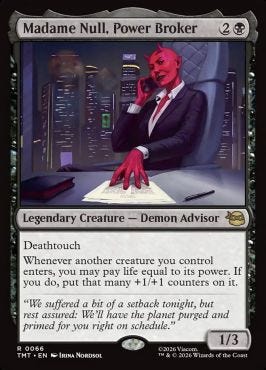
Madame Null, Power Broker:
Getting a 4-power creature for 1 via a Bloodsoaked Champion or a bog standard 2-power 1-drop is really good without having to pay a ton of life and in matchups where your own life doesn’t matter much, this could enable some absurd burst damage. Doesn’t do a lot as a ⅓ deathtouch, but deathtouch at least helps it stonewall other things if need be.
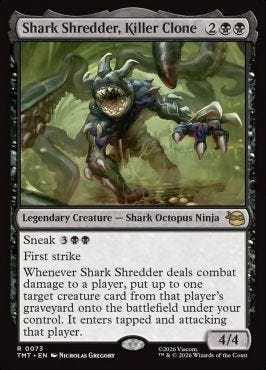
Shark Shredder, Killer Clone:
Ink-Eyes used to be a decent curve topper in aggressive decks, and a decently statted first striker helps this to not just trade with a couple of 2/2s. I’m unsure if that’s enough these days, like if I’d rather just have an Elegy Acolyte.
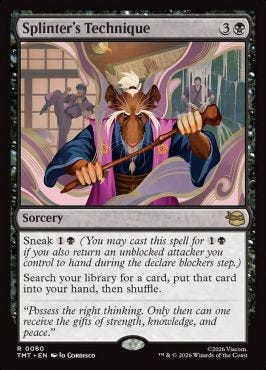
Splinter’s Technique:
I’m unsure how often this is going to be a Diabolic Tutor vs a Demonic, since the former is pretty awful by cube standards. It being printed in a mainline MTG standard-legal set makes me think it ain’t gonna be broken, honestly, but maybe it can get there if a deck can reliably sneak this.
Red:
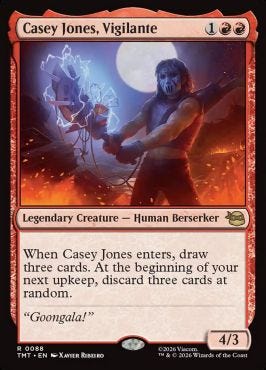
Casey Jones, Vigilante:
These kinds of “until end of this/next turn” draws tend to have diminishing returns, as Jim Davis pointed out when talking about Burning Curiosity, but I think the raw rate of getting several cards ala Seasoned Pyromancer, is an upside worth it. I had it in a deck that wasn’t able to use it well, but hopefully a non-trainwreck deck can play it in the coming months.
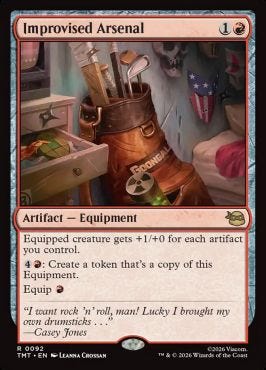
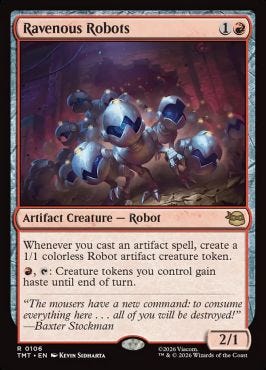
Improvised Arsenal and Ravenous Robots:
Cranial Plating never really took off in cubes like Nettlecyst has, and I figured that the ability to clone itself would help, as the double black ability usually didn’t come up that often and being able to clone itself theoretically helps it to reach its acceptable floor (getting 3+ artifacts in play.) I’ll find that out later, though. Ravenous Robots’ first showing wasn’t great, since it was mostly just a worse Young Pyromancer although that may just change with increased artifact density, but it at least has another ability to give other tokens haste, which hasn’t come up yet but it likely will.
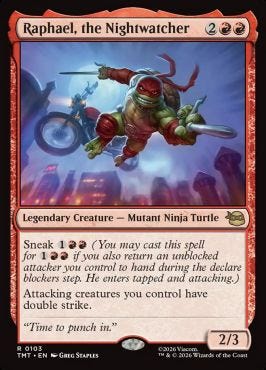
Raphael, the Nightwatcher:
I’m still a fan of Embercleave in cube and this performed similarly-ish to that when it was played, where it just made combat math a bloodbath as a surprise Blade Historian. It’s arguable that other 3s don’t require setup but the payoff is *really* high on this as it was a small miracle that the opponent had an answer to it when it was snuck into play.
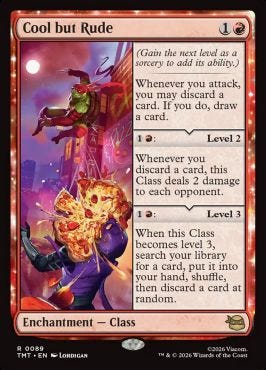
Cool But Rude:
We’ve seen a lot of “Discard matters” types of cards, and the juice could be worth the squeeze here, although the second chapter’s mode not being restricted to once a turn can make for some absurd kills out of nowhere with a free discard outlet. It emulating a Sulfuric Vortex isn’t as useful these days, but being a free damage source, even if it’s on an attacker triggering the Class by itself, could be great.
Green:
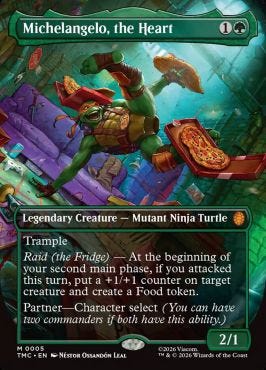
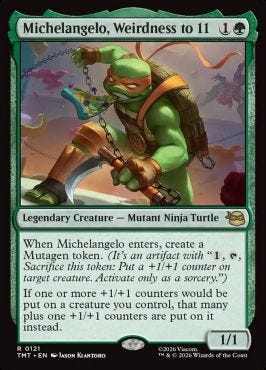
Michelangelo, the Heart and Weirdness to 11:
I like both of these as early beaters, and although I’m not a big fan of “counters matters” as a powerful archetype for Weirdness to 11, a lot of good green cards (Scythecat Cub, Bristly Bill, Badgermole Cub, Ouroboroid) tend to care about putting counters on things like Nadu (or just a ham sandwich.) Michelangelo, the Heart has been pretty solid as a cheap beatstick that grows, and the food token ain’t nothing either.
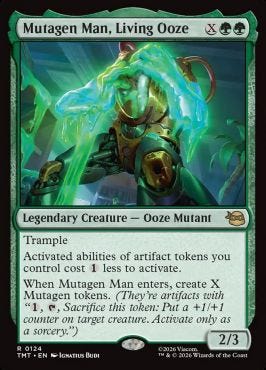
Mutagen Man, Living Ooze:
As something that can make a lot of rectangles, like James, Wandering Dad from Fallout, it’s something that can make things that care about raw artifact counts very happy, with an activated ability that’s nice with clues and maps. But I mostly see this as an X spell that can, theoretically spread its power amongst other things. It’s pretty gross with Nadu, obviously, but like with Agent Bishop, it’s also nice with Valiant cards like Heartfire Hero and Emberheart Challenger.
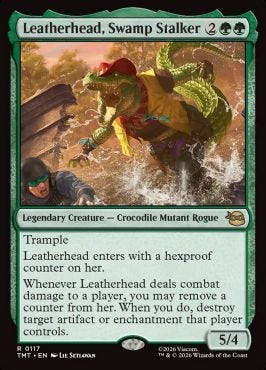
Leatherhead, Swamp Stalker:
I mainly look at this as primarily a pile of hexproof + trample stats, and secondarily an artifact/enchantment hate piece, similar to Scrapshooter where it mainly gets there in cubes that include it from it being an over-rate creature that can shoot things if need be. I’m hesitant to say it can’t compete with the stacked cast of green 4-drops in a lot of cubes, but I’m curious to try it.
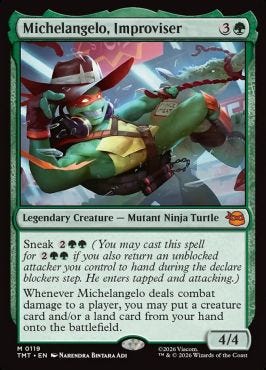
Michaelangelo, Improviser:
This Michaelangelo was in the same deck with Donatello from earlier. I have high hopes on this being a cheat effect that can also be a creature (kind of like Superior Spider-Man) and while I don’t see its land cheating ability mattering too much, it can’t hurt to have added there. In the undefeated deck, it didn’t cheat out much but the potential is really high on this one, since its stats aren’t just trash like Elvish Piper, Oviya, Automech Artisan and the like.
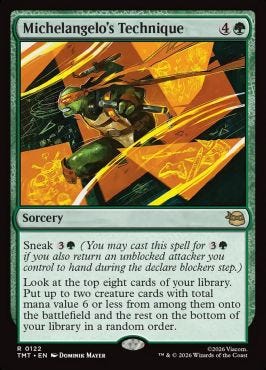
Michaelangelo’s Technique:
A less efficient but less restrictive Collected Company that I don’t have high hopes for, since it’s a sorcery but being able to potentially get 4-6 mana cards with it can help with the hit rate, since, theoretically, it can be more of a generalist card… although, arguably, not a good one. I’m curious if it works out as a way to be included in more decks since CoCo decks in cube can be build-around, although usually, it’s not that hard to.
Multicolor:
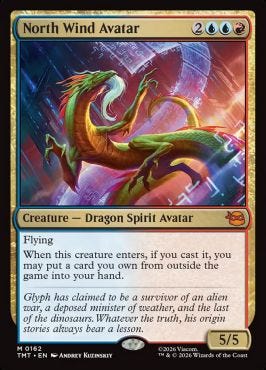
North Wind Avatar:
I’ve lately been exploring the space of cards that get cards from outside of the game, with cards like some wishes and lesson/learn. It’s at least a 5/5 flier for 5 and can get anything, which makes stuff like Gnarled Professor look more embarrassing.
This being a nombo with non-cast ways to bring it in (reanimation/blink) is a loss but probably not a huge one, since getting anything from your sideboard is something that’s really underrated as an unexplored space for evaluation.
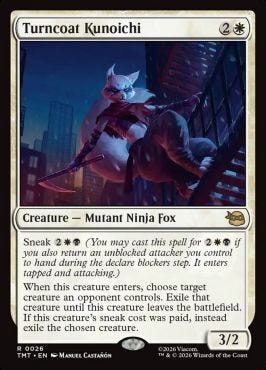
Turncoat Kunoichi:
I’ve liked this so far, as something that emulates classics like Fiend Hunter, and as a removal effect in BW decks that’s stapled onto a creature that doesn’t have to connect to do its thing (so killing it doesn’t do a whole lot if snuck out.) That said, with how good white 3s are, I’m curious to see how often this gets sneaked out, since it’s mostly just fine as a white card.
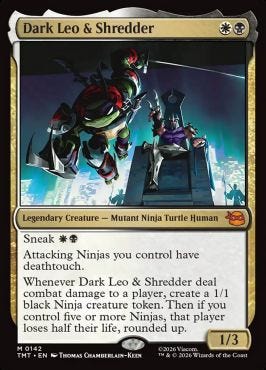
Dark Leo & Shredder:
As a cheap ninja that has deathtouch on attack, it’s not hard to enable this with early drops and is a pretty absurd value if it connects, since it kinda emulates a Krenko’s Command, since I don’t see its “if you control 5 ninjas” thing being much more than flavor text.
It at least gives some immediate return when you get in with damage, and having 2 attacking deathtouchers ain’t nothing, even if the clock isn’t great (since it’s only 2 damage.) It also can at least be deployed for just BW, not 2BW or something annoying like that.
Hybrid:
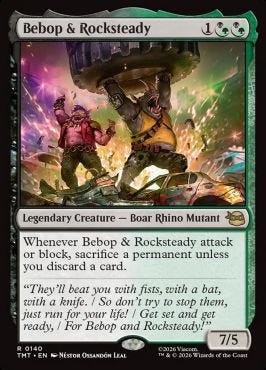
Bebop & Rocksteady:
They’re a big pile of stats which doesn’t lock your draws like Rotting Regisaur did, and it’s about as big. I’m unsure how much of a green card it is, but it could be a pile of stats that can be ramped out on turn 2 with a mana dork. It’s been nice and curious to see if it can be a modern successor to Reggie that we’d seen in cubes before.
If anything, there’s always Abigale to take away its drawback (which isn’t even strictly a drawback for decks that want to sacrifice things/discard things.)
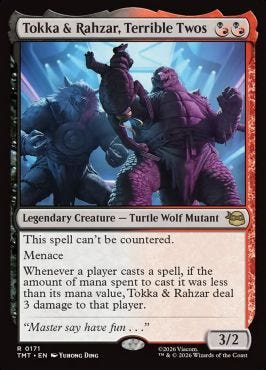
Tokka and Rahzar:
I’m mostly interested in this as as another symmetrical damage piece like Mai, Scornful Striker or the former staple Eidolon of the Great Revel as a way to deal damage, even if it’s a double-edged sword (Manabarbs’ flavor text approves.) Its first deck had it in a red deck with several cards that made its symmetrical drawback happen more often than I’d have thought via cards like Embercleave, other ninjas like Raphael, the Nightwatcher, etc. Stats are great though and although it’s a B/R card, nothing’s stopping a clever drafter from using it in a base red (or black) deck.
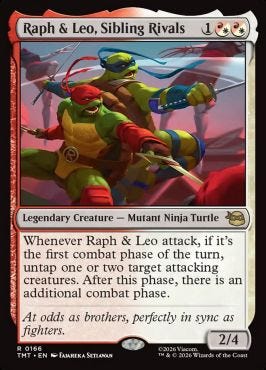
Raph and Leo, Sibling Rivals
While most cards that let someone attack twice, although there’s a few solid exceptions: Grim Reaper’s Sprint, FOMO and the fragile Combat Celebrant come to mind. Being a 2/4 means it likely won’t die in combat, either, and being able to swing for 4 - if unimpeded - is nice too. White and red 3s are just so stacked that I’m curious how often this’ll just be a sideboard card against aggro decks.
Artifacts/Colorless:
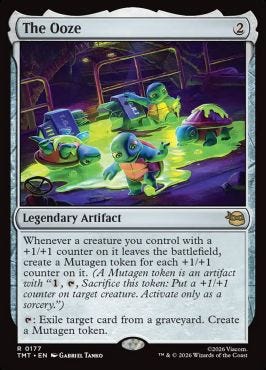
The Ooze:
What piqued my interest was that this makes a lot of artifacts rectangles pretty easily and then acts as a secondary graveyard hate piece. It’s nice that when the mutated creature dies, it still leaves something behind too, which can help maintain things like metalcraft and/or make things like Nettlecyst massive.
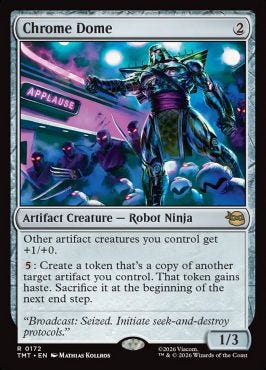
Chrome Dome:
Its floor is eh and plays a role similar to Iron Spider, Stark Upgrade as an artifact lord as something that needs other artifact creatures to work well, for its boosting and relatively inefficient cloning ability. I talked in the EoE review about incidental artifacts being helpful to make the critical mass of cards for artifact density to work, although I’ve not seen that come into fruition. That may come to pass, though, since we have a ton of sets coming in 2026.
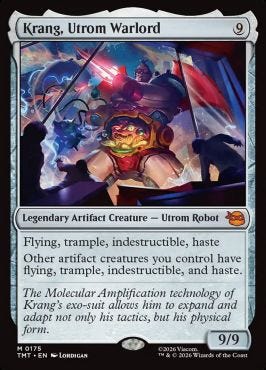
Krang, Utrom Warlord:
Potentially, another big robot to cheat into play as a Blightsteel-type finisher, and thankfully this one has haste. I’m unsure how often its Akroma’s Memorial-style boost will matter for other robots, since this doesn’t help Living Weapons (Kaldra Compleat, Nettlecyst) which tend to be played in the same decks that would want Krang.
Thanks for reading! You can find my socials and my cube lists on my Linktree, as well as other cube set review articles and design articles that I’ve written over the last 15 years.

Really smart approach documenting these initial takes. The Settle the Wreckage example nails why this matters, how evaluation bias creeps in when we dont revisit first reads. I've been guilty of the same thing witj cube testing where initial dismissals stick around way longer than they should. Donatello copying cheap artifacts feels slept on here, reminds me of how long it took people to realy see Retrofitter Foundry's potential.