
2025 Cube Cards: Set Overview

Like many people do at year’s end, I’ve been reflecting on 2025, which naturally led me to think about the year’s cube sets, which gave me the idea to write a post‑mortem and overview of the 2025 cube releases.
Earlier this year I posted a cube post‑mortem for Duskmourn and noted how rare in‑depth card evaluation pieces are. Since this Substack began in late 2024 with a post‑mortem on how Murders of Karlov Manor performed in cube and how my views on those cards evolved, it feels fitting to close the year with a similar review of 2025’s cube sets.
As usual, I’ll group cards by set and by their supplemental products, and I’ll highlight a few underrated 2025 cards, as I did in 2024.
I’ll rate every card relevant to “power‑motivated” cubes on a 1–5 scale. Following the MKM post‑mortem, I’ll call out cards I didn’t discuss previously and explain where my evaluations have changed. I won’t cover every card, since that’d be a novel and if you’re looking at the scroll bar on the side, this is going to be lengthy to read anyway. Instead, I’ll note cards whose evaluations have shifted and include cards I hadn’t discussed before.
In the card listings, I’ll mark previously unmentioned cards in italics and show cards whose ratings changed in power ratings in bold.
Table of Contents:
Aetherdrift:

For comparison, here’s the original Aetherdrift article and how ratings shifted:
Stock Up: 5 (+)
Monument to Endurance: 2.5-4
Marauding Mako: 3-4 (+)
Ketramose, the New Dawn: 2.5-4 (+)
Thunderous Velocipede: 3.5 (-)
Draconautics Engineer: 3 (+)
Greasewrench Goblin: 3.5 (-)
Loot, the Pathfinder: 3.5
Agonasaur Rex: 3 (-)
Marketback Walker: 3 (-)
Quag Feast, Grim Bauble, Momentum Breaker: 2-3 (-)
Fuel the Flames: 2.5
Webstrike Elite: 2.5 (-)
The Aetherspark: 2.5 (-)
Aetherdrift cards that I’d previously discussed:
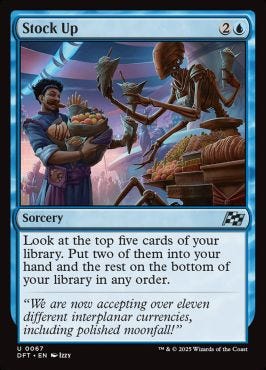
Stock Up (+)
Like many others, I initially underrated this card, dismissing it as yet another large blue draw spell unnecessary in cube decks that already have enough card draw. Cards like Fact or Fiction have felt long in the tooth, and the fact that this one is a sorcery made me underestimate its card‑selection power, which is a major reason it has become such a strong source of blue card advantage. I don’t see it leaving cubes anytime soon since it fits so naturally into blue decks.
On the Cube Engineers 2025 wrap‑up episode, I explained how Stock Up taught me to watch for the evaluative trope “this isn’t needed, so I won’t spend mental calories on it.” Doing so can lead to myopic analysis, which is something I’ve always tried to preach against in cube analysis, but Stock Up caught me slipping.
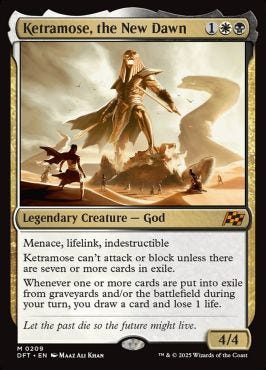
Ketramose, the New Dawn (+)
Orzhov typically supplies role‑fillers with cards like Vindicate, Lingering Souls, and Kaya’s Guile that play to the pair’s midrange strengths, but it rarely produces a true build‑around card. Ketramose tends to require some build-around in deckbuilding but usually the payoff is worth it since it shines when paired with cards such as Ghost Vacuum, becoming a draw engine backed by a hard‑to‑block, lifelinking attacker where the juice has been worth the squeeze.
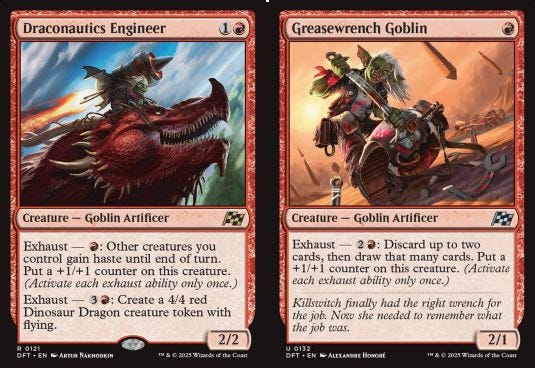
Greasewrench Goblin (-), Draconautics Engineer (+)
The old trope that a 2/1 for one is the “best cube card in the set” comes from a time when we needed more 1‑drops for aggro decks. That hasn’t been true for years since nowadays, we have many more options to customize what we want from our 1-drops in aggro sections.
I’ve started treating these ratings less as “will this card make it into cubes?” and more as “how well will this card perform in a cube?” On a pure “works across power levels” basis, Greasewrench Goblin still performs well, but it’s ultimately a replacement‑level 1‑drop: a 2/1 for one with text that matters in the late game and some extra value for decks that want to fill the graveyard.
Draconautics Engineer was similar in the opposite direction: a role‑filler that performed better than its initial reception suggested. I don’t know why I rated it a 2, especially after writing “It’s, so far, been much better than expected,” so that was likely an error.
Both cards are replacement‑level but solid toolbox pieces for aggressive strategies.
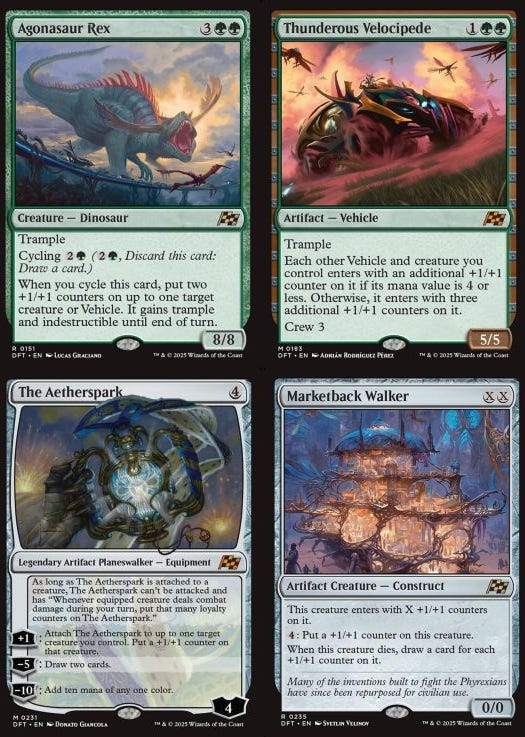
Thunderous Velocipede, Agonasaur Rex, Marketback Walker, The Aetherspark (-)
I’ve grouped these as “go big” green payoffs that underperformed compared with my initial hopes for big‑green decks. Velocipede and Agonasaur, however, proved more useful when integrated into other archetypes: Velocipede as token support and Agosanur as a beefy combat trick. Velocipede, in particular, remains an underrated support card that I haven’t seen in a lot of cubes, but I’ve enjoyed it as a green support card in decks that can spit out multiple tokens at once.
Marketback Walker and The Aetherspark will likely enjoy extended shelf life because they’re colorless, but I don’t expect them to stick in most cubes once 2026’s wave of sets completes.
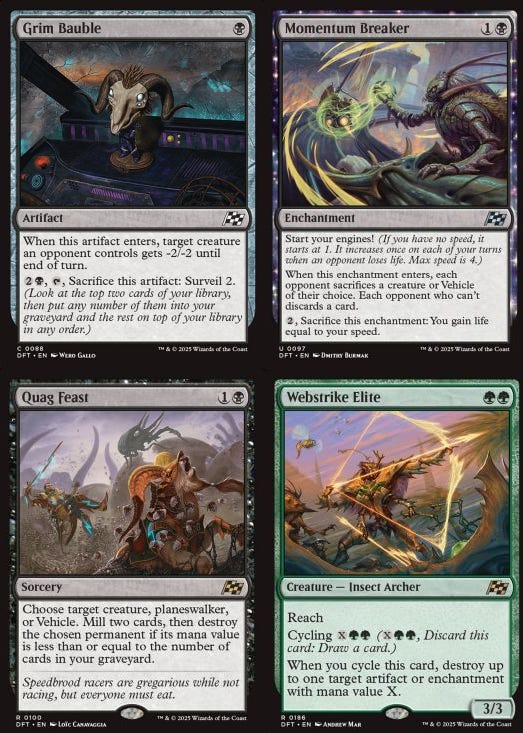
Quag Feast, Grim Bauble, Momentum Breaker, Webstrike Elite (-)
These cards broadly serve the same role by being removal that trades efficiency for a bonus: either graveyard enabling or leaving a permanent to bounce or use as a card object. Ultimately, I found the sorcery speed, much like with Virtue of Persistence, to be an annoying drawback that caused them to underperform over time.
Webstrike Elite was similar in being a jack‑of‑all‑trades, master‑of‑none. Its value was as a toolbox piece acting as a Naturalize‑style answer that can also be a creature, rather than a reliable, generalist green card. Not the worst place to be, but it tended to drift in and out of cubes.
Aetherdrift cards that I’d previously not discussed:
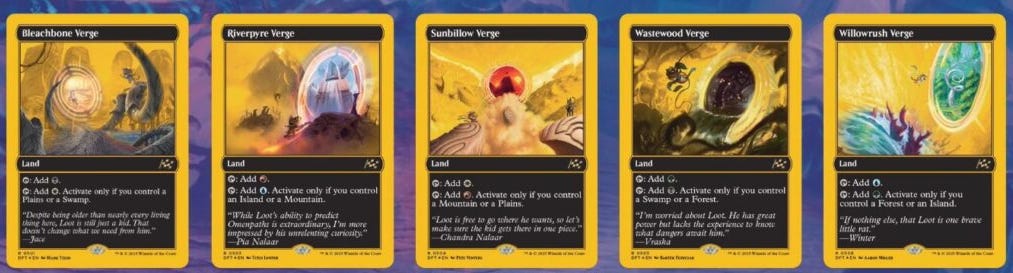
The Enemy-color Verge land cycle
I didn’t mention these lands in my initial article, but they’ve proven solid as they enter the battlefield untapped, which helps decks that want to curve out and I’ve been pleased with them. They’re not staples on the level of the original fetchlands, duals, shocklands but beyond those, there aren’t many must‑have fixes in the land cycles. That makes their inclusion something that a designer can use to nudge archetypes toward the cycles’ particular strengths and weaknesses.
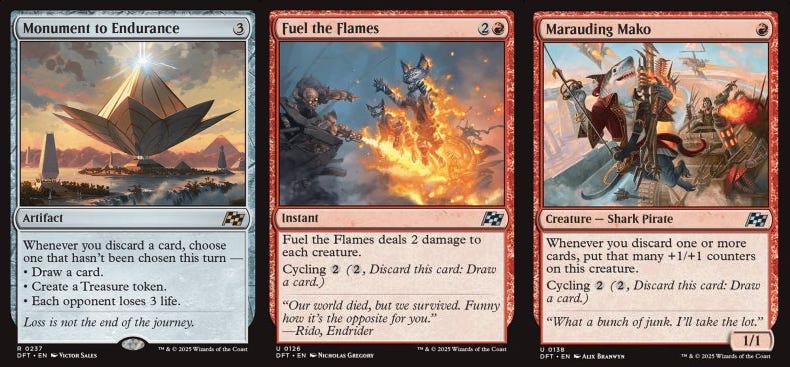
Monument to Endurance, Marauding Mako, Fuel the Flames
Aetherdrift provided strong payoffs that pushed red toward discard‑centric archetypes via supporting reanimation, madness and more midrange strategies. Historically, that macro‑archetype showed up as Wildfire or “big red,” which often underperformed compared with blue‑based control. Cards like Monument and Mako give red meaningful incentives to play discard synergies, making cards such as Ivora and other discard‑caring pieces more viable.
The discard theme was added in the most recent update of the MTGO Vintage cube and reception to the discard cards has been positive so far.
Meanwhile, Fuel the Flames has largely been supplanted by Fire Magic in cubes that wanted another small wrath.
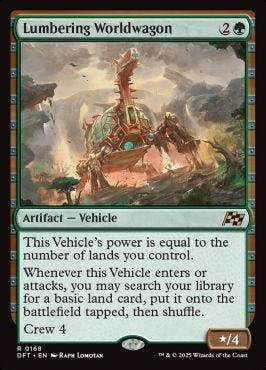
Lumbering Worldwagon
I had dismissed this card as worse than other green three‑drops, but it has performed better than I expected. One benefit that didn’t materialize until the Final Fantasy set was how effectively it enabled landfall strategies, functioning like a mini‑Primeval Titan.
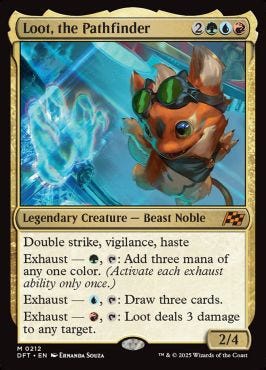
Loot, the Pathfinder
Magic’s little guy initially suffered the same fate as other three‑color cards in cube: tri‑color requirements naturally limit which decks can play them. Green decks, however, handle such cards more easily because their mana fixing is stronger. Its best uses have been as a permanent to sacrifice under Agatha’s Soul Cauldron or as a repeatedly blinkable threat enabled via cards like Airbender Ascension and Displacer Kitten, which is essentially game over if its blue ability can be activated a few times. Even its floor, four hasty power for five mana, wasn’t the worst either.
Tarkir: Dragonstorm:

For comparison, the original Tarkir: Dragonstorm article and how ratings shifted:
Cori-Steel Cutter: 5 (+)
Clarion Conqueror: 3.5-5 (+)
Sage of the Skies: 3-4.5 (+)
Voice of Victory: 4.5
Ugin, Eye of the Storms: 4.25
Surrak, Elusive Hunter: 3.5-4
Kishla Skimmer: 3-4
Shiko, Paragon of the Way: Power: 3-4 (-)
Tersa Lightshatter: 3.75
Avenger of the Fallen: 3-3.5 (-)
Marang River Regent: 3.5
Sunpearl Kirin: 3.5
Descendant of Storms: 3.5
Rally the Monastery: 3.5
Aligned Heart: 3.5
Frostcliff Siege: 3.25
Rakshasa’s Bargain: 3 (-)
Songcrafter Mage: 3 (-)
Auroral Procession: 3 (-)
Frontline Rush: 3 (-)
Scavenger Regent: 2.5 (-)
Rot-Curse Rakshasa: 2.5 (-)
Twinmaw Stormbrood: 2.5
Qarsi Revenant: 2.5
Sinkhole Purveyor: 2.5
Tarkir: Dragonstorm cards that I’d previously discussed:
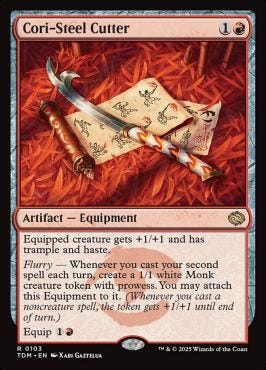
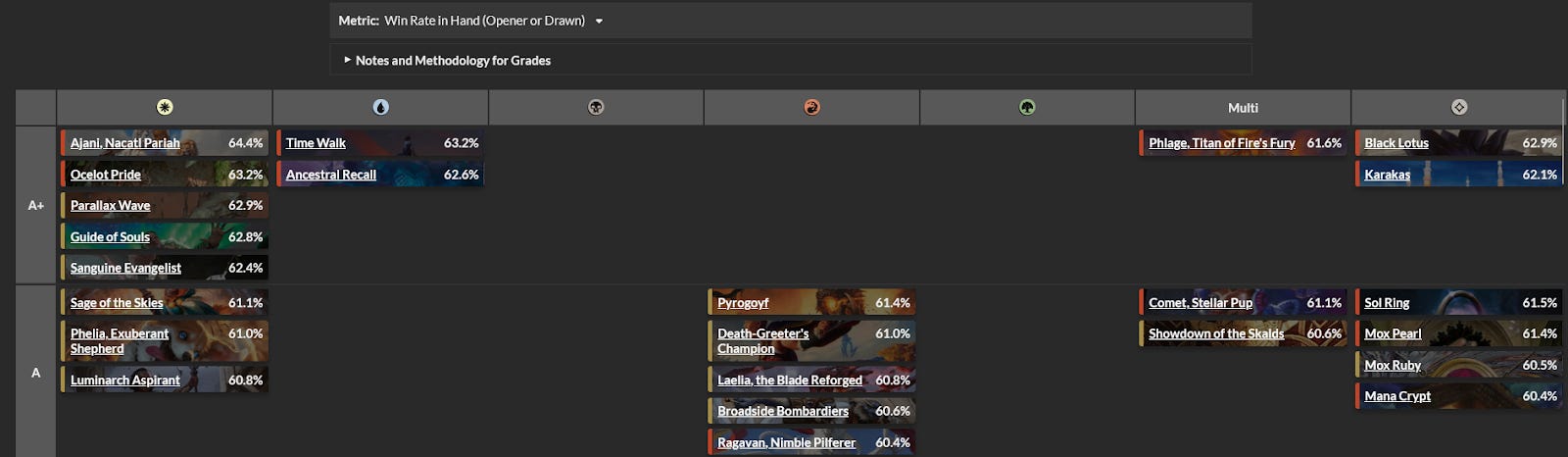
Cori-Steel Cutter (+)
Anyone who’s seen this card played shouldn’t be surprised that this was equipped for free far more often than it was a fair piece of equipment and it’s become one of red aggro’s standout cards over the past year. Arguably, it’s the archetype’s best addition and the crown jewel of the “cast 2” strategy, which also received several supporting cards this year but even outside of the archetype, it’s just a great red card. In the initial article, I noted that the question I always ask for these non-creature cards for red aggro is if it’s better than a bog standard burn spell. I think it’s now clear that it very much is.
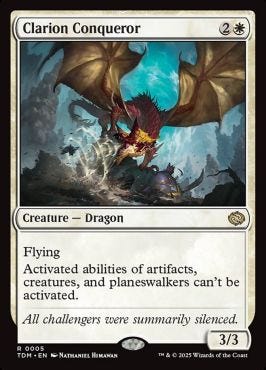
Clarion Conqueror (+)
While fairly middling when there isn’t much to hate, it often performs closer to its ceiling because many cubes include plenty of artifacts and creatures to target, and the ability to shut off planeswalkers is a useful bonus. White 3-drops are a dime a dozen in cube now, but its high ceiling makes it effective in metas with abundant things to hate.
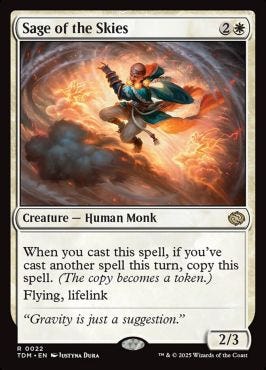
Sage of the Skies (+)
I liked this card when I tried it as it has a solid floor as a Vampire Nighthawk‑style threat and its flurry is easy to enable, letting it punch well above its weight class. Like Cori-Steel Cutter, it’s a strong “play‑2” payoff, though it can’t operate at instant speed. It returned to my radar after performing well in the MTGA Powered Cube, partly because Boros aggro being strong helped its winrate, and being good in the mirror helped too. But even outside that context, it usually made a couple of bodies and and held up well against spot removal and countermagic.
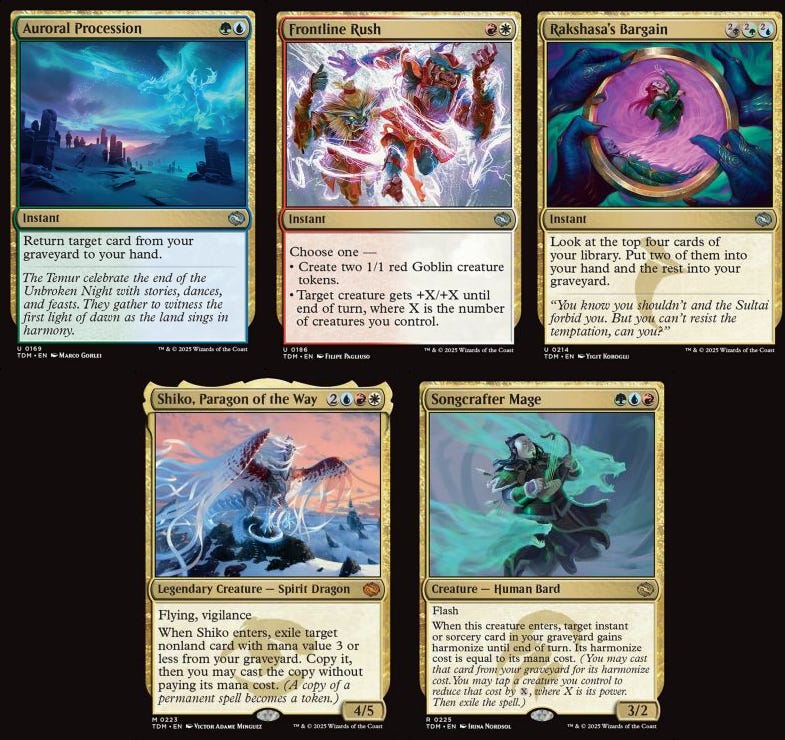
Rakshasa’s Bargain, Songcrafter Mage, Shiko, Paragon of the Way, Auroral Procession, Frontline Rush (-)
I rated these lower than in my initial article since I found them to be fine multicolor cards, but ones that faced stiffer competition as the year went on and ones that ultimately got crowded out of cubes. Shiko stands out as one of the better Jeskai pieces in recent memory, especially when it can cast something like Stock Up. Frontline Rush typified the competition angle as a solid card but ultimately was worse than other Boros cards.
Unsurprisingly, I rarely saw Rakshasa’s Bargain cast for four mana; it usually functioned as a three‑mana tri‑color card, which was perfectly serviceable. Green and blue generally have an easier time casting tri‑color cards, green because of better fixing, blue because it often plays the long game, but many of these prints didn’t stick around in my cube for long and saw other cubes follow similarly.
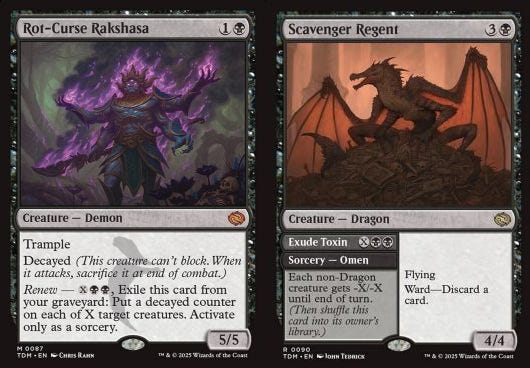
Scavenger Regent, Rot-Curse Rakshasa (-)
Both of these cards proved rather slow, and neither mode fit the archetypes I had in mind—midrange or aggro. I had higher hopes for Scavenger Regent, but its wrath was too costly and its body was middling, similar to Decadent Dragon, so neither card reached the baseline needed for slower black decks.
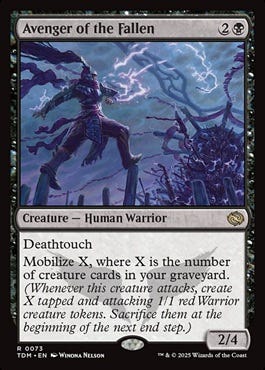
Avenger of the Fallen (-)
Generally, I found this to be an inconsistent performer, but it still has a pretty good floor if proactively enabled via self-mill and sacrifice. I just wasn’t too impressed with it as a generalist beat-stick and slower black decks usually deferred to other things, which wasn’t what I expected given Avenger’s 2/4 deathtouch body.
Tarkir: Dragonstorm cards that I’d previously not discussed:
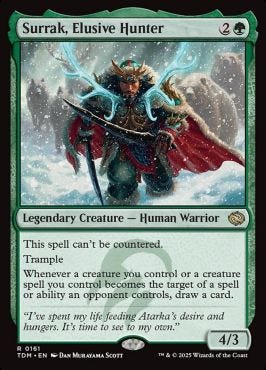
Surrak, Elusive Hunter
This Surrak has a known vulnerability to Orcish Bowmasters (death from infinite pings) but it functions as one of the stronger Shapers’ Sanctuary style effects and an effective way for green decks to fight spot removal, since it at least nets you a card when targeted.
Being only a 4/3 for 3 is ok by 2025 creature standards, which has limited its adoption. Still, it performs the role of Spinner of Souls even better in many matchups, so despite its unimpressive raw stats it remains a useful inclusion as a toolbox option for giving green an option against removal-heavy decks.
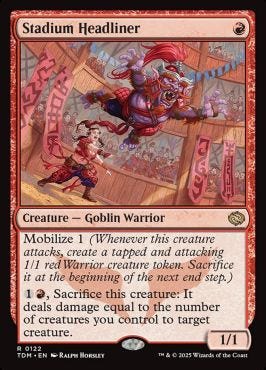
Stadium Headliner
Like Sage of the Skies, this card returned to my radar after success in the MTGA Powered Cube. In testing it performed on par with other red one‑drops but has some nice synergies by working well with pump effects or ways to use temporary bodies while dealing the same damage on an empty board. The sacrifice ability rarely came up, but it’s an avenue worth exploring to increase the card’s value.
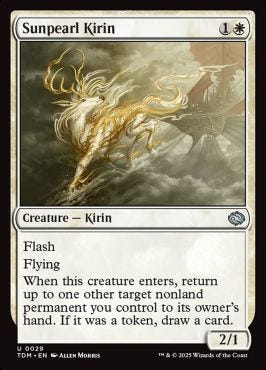
Sunpearl Kirin
This is one of the better self‑bounce cards: it works well as a 2/1 with flash, much like Samwise, and functions effectively as an on‑curve creature in aggressive decks where it’s typically played. It requires less support than Nurturing Pixie, which performs well in cubes with many bounce targets and although I haven’t seen it paired with Avatar’s flash payoffs yet, that interaction should be a useful upside for those strategies.
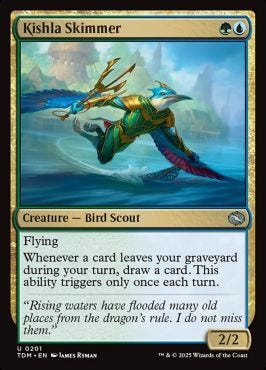
Kishla Skimmer
If you can trigger it twice, through cards like Ghost Vacuum, Delve, or other self‑recursion effects, it becomes one of the stronger cards in a deck. It’s a solid consideration for lists that don’t have access to the absurd Simic cards like Oko and Nadu.
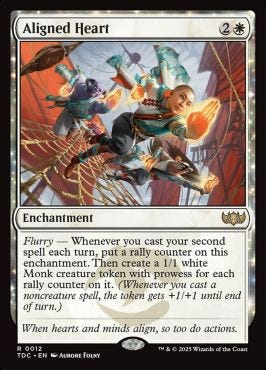
Aligned Heart
This is similar to Kishla Skimmer in that it generally needs about two triggers to justify itself. I’ve been testing it because it has potential to be a good card, but it hasn’t seen play yet. I’m cautiously optimistic it can get there with the right shell and support.
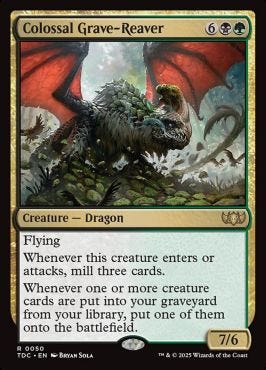
Colossal Grave-Reaver
I’m mostly mentioning this as something that can act like a cascade “ultimatum” type of effect as something that can reanimate something else with its mill trigger or other self-mill ala Town Greeter.
Final Fantasy:

For comparison, the original Final Fantasy article and how ratings shifted:
Vivi Ornitier: 5 (+)
Tifa Lockhart: 2-5
Cecil, Dark Knight: 4.5
Opera Love Song: 4.5
Summon: Kujata: 4.5
Sazh’s Chocobo: 3-4.5
Yuna’s Whistle: 4.25
Cloud, Midgar Mercenary: 3.5-4 (-)
Sephiroth, Fabled SOLDIER: 3.5 (-)
Summon: Bahamut: 3.5
Sleep Magic: 3 (-)
Fire Magic: 3
Suplex: 3
Town Greeter: 3
Commune with Beavers: 3 (-)
Ambrosia Whiteheart: 2.5-3 (-)
Resentful Revelation: 2.5
Thunder Magic: 2.5
Final Fantasy cards that I’d previously discussed:
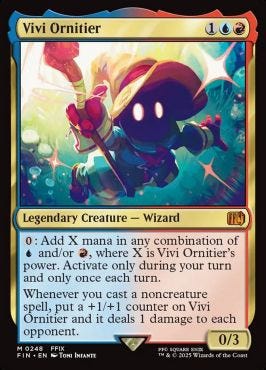
Vivi Ornitier (+)
In my original review I ranked it as arguably the second‑best Izzet card behind Expressive Iteration, mainly because I worried about it dying to removal. I now think it’s much closer to that top spot, even outside of Cauldron shenanigans.
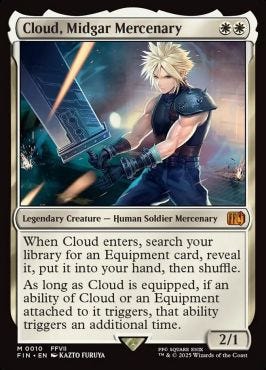
Cloud, Midgar Mercenary (-)
The WW cost mattered more than I expected, but Cloud was more of a fit for aggressive decks anyway. For the most part it functioned more as a synergy piece with Umezawa’s Jitte, Heirloom Blade and Skullclamp, and fit better in more aggressive equipment shells than Stoneforge Mystic but losing splashability and the ability to cheat in Batterskull and Kaldra Compleat were annoying drawbacks. The double-white requirement restricted its inclusion in decks but it still performed pretty well. If 2026 follows 2025’s trend of strong white two‑drops, it may be hard to justify including it but that could also change if more utility equipment is printed.
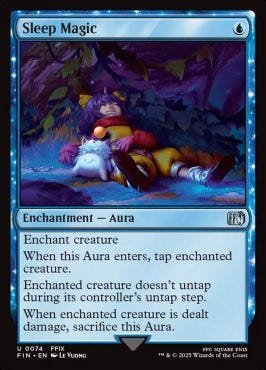
Sleep Magic (-)
I found Sleep Magic better than Unable to Scream for pure tempo, but worse against creatures with static abilities like Sheoldred, Orcish Bowmasters and Icetill Explorer. Unable to Scream usually did the job of neutralizing a creature by turning those creatures into 0/2s, so over time I came to favor it and viewing Sleep Magic as more of a toolbox card to boost tempo strategies.
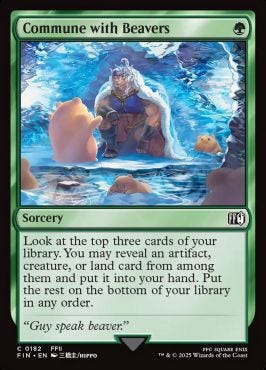
Commune with Beavers (-)
This may just reflect my waning enthusiasm for sorcery‑speed, cantrippy cards that look at your top X cards and find something that matches a criteria (although I love Thundertrap Trainer, go figure.) For the most part they act as glue by getting a creature or land when you’re mana screwed, and I cut this one from my cube for feeling pretty mid, especially since Oath of Nissa already covered the role. I do appreciate that it nudges green artifact decks a bit, much like Tough Cookie.
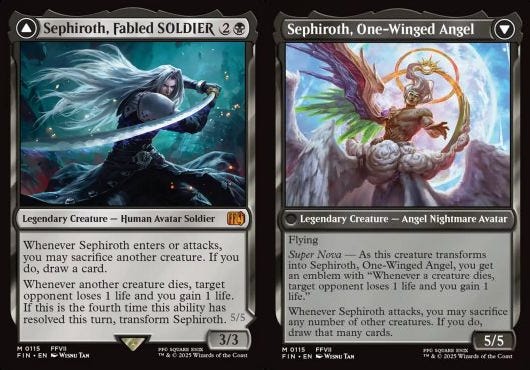
Sephiroth, Fabled SOLDIER (-)
This is probably the best Blood Artist we’ll see since it has a very real 3/3 body. I’m not a fan of sacrifice strategies in high‑powered cubes since the archetype is generally not that great, but as a black three‑drop it’s been strong, facing less competition than similar cards in white or red. It’s absurd with Mobilize tokens and evoke, though I haven’t actually seen those synergies or the flip trigger much, but I’m sure that’ll be a nice bonus when it occurs as Lorwyn Eclipsed should bring more good evoke creatures to cubes.
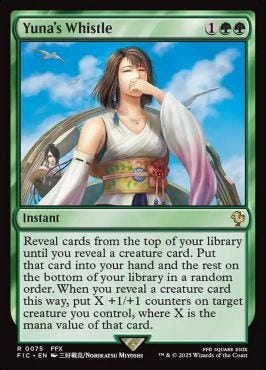
Yuna’s Whistle
My opinion of this card hasn’t changed, but I’m calling it out because it’s been underrated in cube discussion. People seem to assume that its performance will match its floor, where it will frequently hit an 1-mana elf, yet even in decks with mana elves that outcome was less common than feared.
More often it functioned as a three‑mana cantrip that doubles as a combat trick that found an actual card. Sometimes you simply end the game by casting it on an unblocked creature and revealing a six‑drop, whether via library manipulation or just YOLOing it. It’s happened!
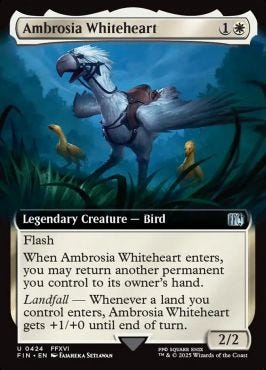
Ambrosia Whiteheart (-)
This played much like Sunpearl Kirin at home, by trading flying for a landfall trigger and the option to be bounced with Karakas. It’s a downgrade but still serviceable, but one that will likely fall out of cubes that currently play it, given the many strong white two‑drops printed this year, which is why I rated its power lower.
Final Fantasy cards that I’d previously not discussed:
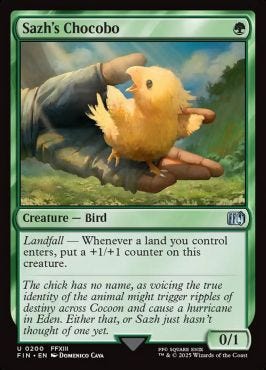
Sazh’s Chocobo
I’ve really liked this as a cheap aggressive beater. It’s a poor topdeck (that applies to most aggro beaters, honestly) but it shines with fetchlands and landscapes, often punching well above its weight class. It’s also solid in green as a super‑cheap Vinelasher Kudzu analogue that only needs two landfall triggers to hit a good rate, which it usually did.
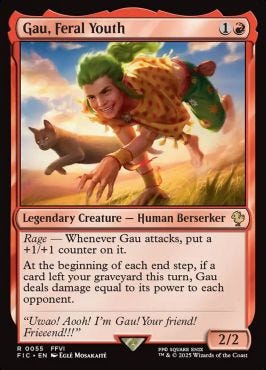
Gau, Feral Youth
Gau has mostly functioned like a self‑buffing Luminarch Aspirant; its graveyard ability is a handy way to squeeze extra damage and shows up more often than you’d expect, even outside RB. Attacking twice usually gets it to a 4‑power threat, which is typically enough to justify running it in a deck that wants to beat down.
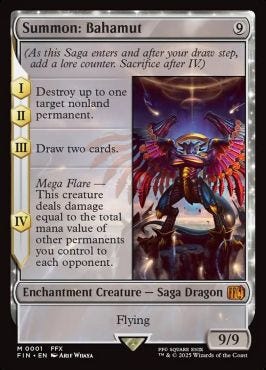
Summon: Bahamut
This has worked well as a cheat target since it destroys a nonland permanent when cast, so it usually accomplishes something. Bahamut almost never reaches his final chapter because its presence already threatens huge destruction and card advantage, though its lack of trample means it can’t get through flying tokens. Still, it generally gets the job done.
Black Mage’s Rod
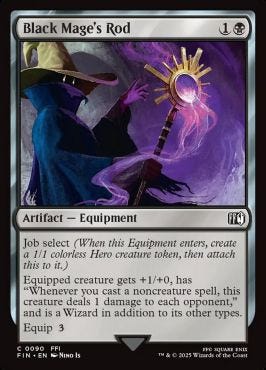
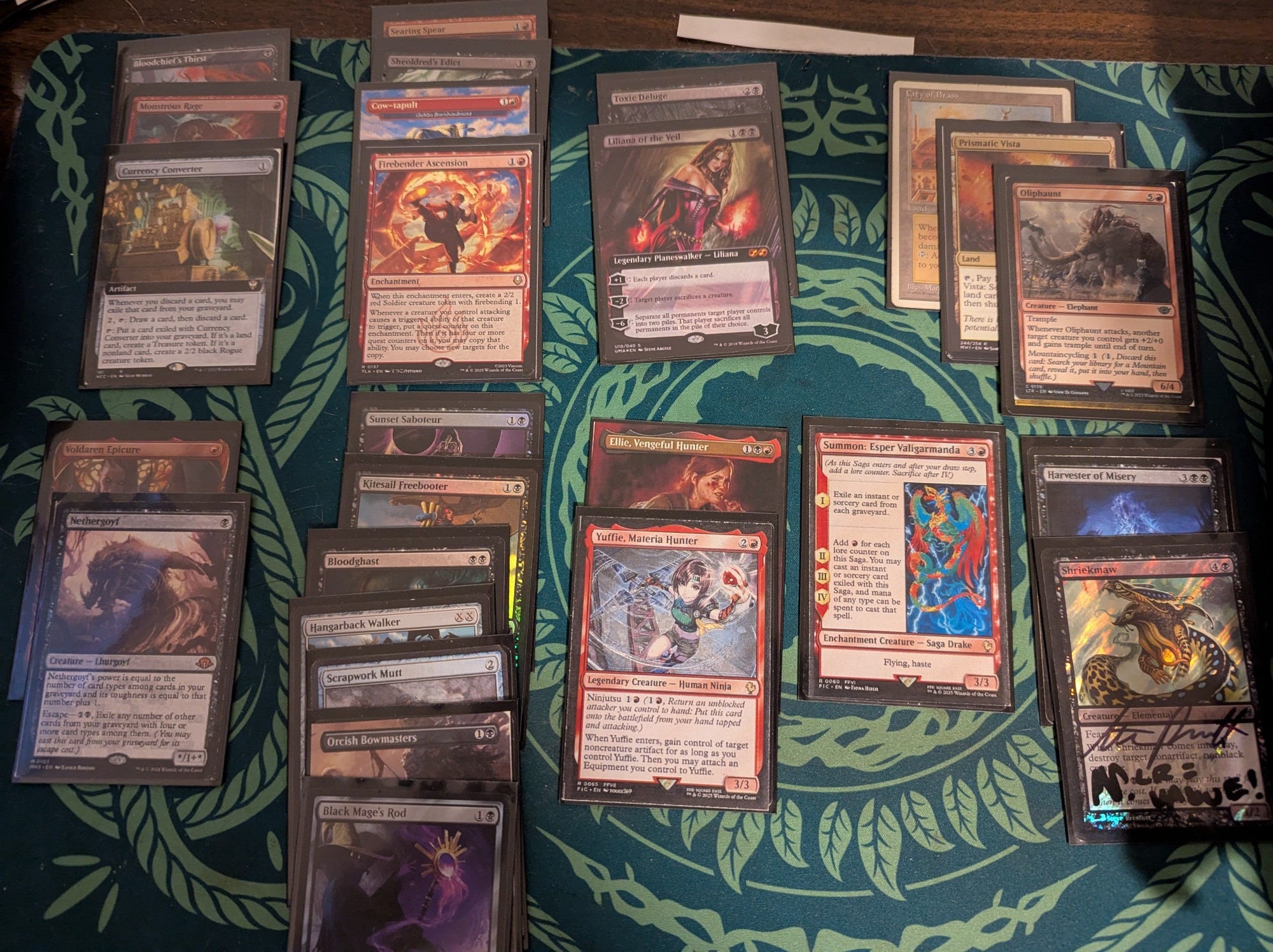
This has been making an impact in pauper constructed but in cube, it’s been replacement-level by virtue of being a 2-drop beatstick ala Firebrand Archer that can be thrown onto something else for a ton of mana. This 2-1 deck is a nice example of it working in a somewhat low-curving deck:
Resentful Revelation
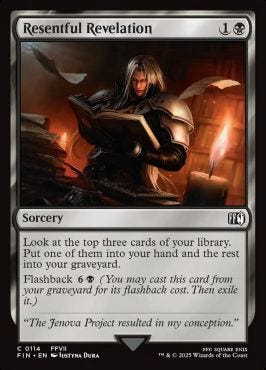
I usually limit set‑review sections to 7–10 cards to keep them readable, so this one slipped through during preview season. It’s a straightforward black card that mills things into the graveyard and provides a late‑game mode as a handy mana sink when you have nothing else to do.
Fire Magic
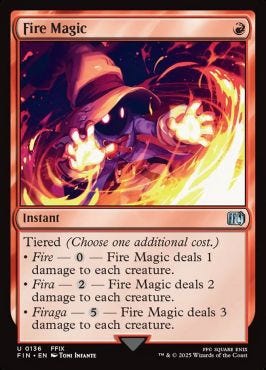
Arguably the best small wrath, it shines because its early modes sweep small creatures at instant speed while still offering a mode that can clear a board of 1/1s or 3/3s when necessary. Most of the time it functions as an instant‑speed “deal 2 to all creatures for 2R,” and that flexibility has made it a solid performer in cubes that run it.
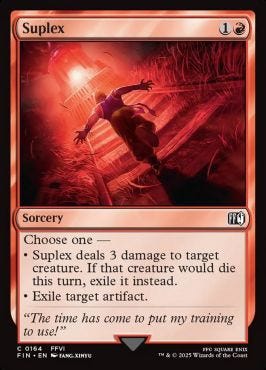
Suplex
Like Abrade, I didn’t feel this was necessary in my cube because it trades instant speed for creature exile. Exiling creatures is a meaningful upside and it’s been doing work in the MTGO Vintage Cube for red decks, but I treat it as more of a surgical scalpel as additional artifact hate and ways to exile cards like Ajani, rather than a generalist removal piece like Abrade.
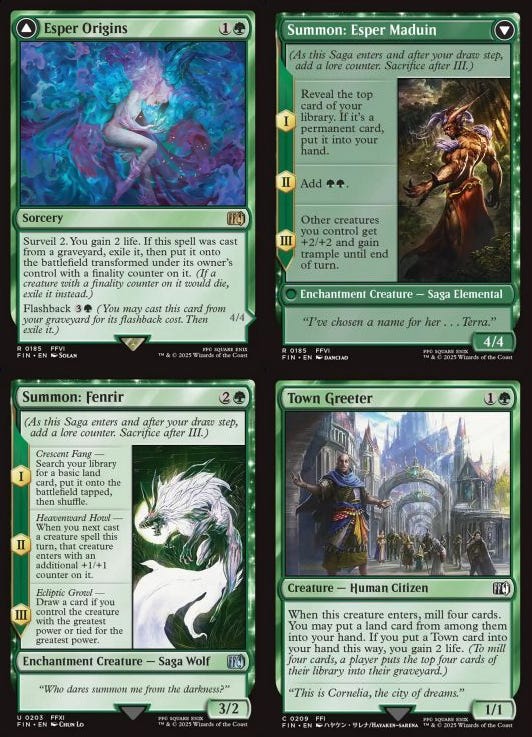
Esper Origins, Summon: Fenrir, Town Greeter
I’m grouping these as support cards for green midrange decks, with Town Greeter essentially acting like a Satyr Wayfinder plus a small bonus. None are likely to be deck all‑stars, but I’ve been pretty happy with Summon: Fenrir, even if I don’t expect it to stick around into 2026.
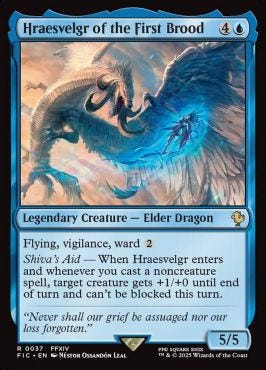
Hraesvelgr of the First Brood
I initially flagged this as an underrated five‑drop, but with Quantum Riddler and the wave of strong blue five‑drops from Avatar, this aggressive‑leaning card is likely cut from many power‑focused cubes because it’s simply outclassed.
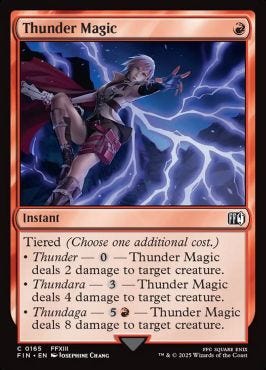
Thunder Magic
This is mainly worth considering as a cheap split removal option that handles 2‑toughness and 4‑toughness creatures. It’s clearly worse than Burst Lightning, but it functions as a useful toolbox piece for cubes that need more low‑cost removal, similar to Abrade as a card for a cube toolbox.
Edge of Eternities:
For comparison, the original Edge of Eternities article and how ratings shifted:
Quantum Riddler: 5 (+)
Tezzeret, Cruel Captain: 3-5 (+)
Ouroboroid: 4-5 (+)
Icetill Explorer: 4.5 (+)
Seam Rip: 4.5
The Endstone: 3.5-4.5. (+)
Cosmogrand Zenith: 4 (+)
Umbral Collar Zealot: 3-4
Pinnacle Emissary: 2-4 (-)
Cryogen Relic: 2-4
Sunset Saboteur: 3.5 (+)
Nova Hellkite: 3.5 (+)
Baloth Prime: 3.5
Elegy Acolyte: 3.5
Starfield Shepherd: 2.5-3.5
Rust Harvester: 2-3.5
Edge Rover: 3 (-)
Lightstall Inquisitor: 3 (-)
Edge of Eternity cards that I’d previously discussed:
Quantum Riddler (+)
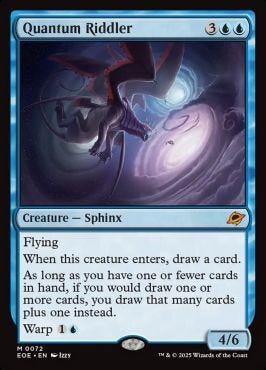
This performed far better than I expected and may be the set’s best cube card: a versatile blue staple reminiscent of a 2025‑era Mulldrifter that lets you get both the evoke and hardcast mode and also shines in blink and aggressive blue shells. It drew two cards more often than I anticipated, and its six toughness makes it awkward to remove without the opponent getting two‑for‑oned.
Tezzeret, Cruel Captain (+)
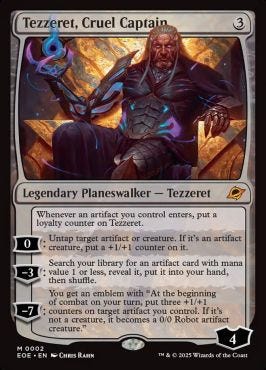
I initially thought it would underperform without a busted target like Trinket Mage, but it’s outperformed expectations, especially in cubes with 0–1 mana rocks and Vault+Key lines. It’s easily top tier among Edge of Eternity cards for unfair cubes, and even outside those shells it’s a solid piece alongside Currency Converter and Retrofitter Foundry since Tezzeret being a planeswalker that can ultimate quickly in the right deck and/or the ability to fetch multiple things, or even to untap mana rocks is big game.
Edge Rover and Lightstall Inquisitor (-)
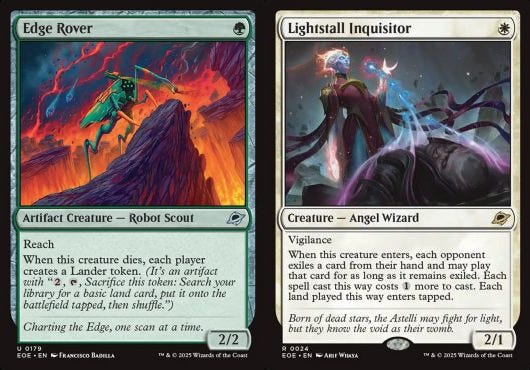
I wouldn’t call either a staple, but they’re serviceable stat‑piles that do their jobs in green and white aggro. Lightstall has been a nice disruptive aggro creature, useful without being absurd, basically another cheap ham sandwich in an archetype that wants a lot of those to beat down an opponent.
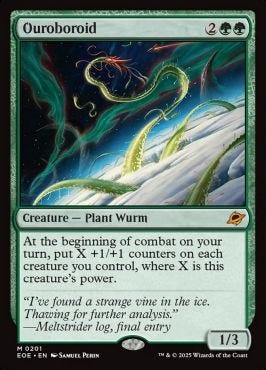
Ouroboroid (+)
This has been a strong “pile of stats” that quickly grows everything you control and can spiral out of hand. On its own, it blocks as a 2/4 and attacks as a 4/6 and it makes other creatures much larger; equipment or planeswalker buffs are nice but unnecessary, so it mostly gets there as a self‑contained engine that gets better with help. Dying to removal is annoying but often an overstated worry, high removal density does hurt and it’s why I only rated it a 3-4 in my initial review despite it being a strong performer in testing. Some call it the “green Shelly” which isn’t a perfect comparison (it can’t solo an opponent like Sheoldred can and is worse against burn,) but the analogy has some legs, since letting it live a turn or two makes life very difficult.
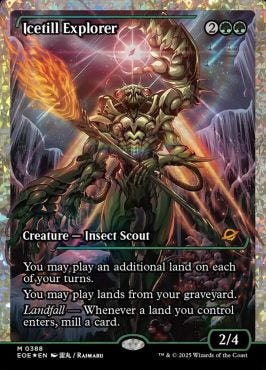
Icetill Explorer (+)
Easily the best‑in‑class with regards to Crucible of Worlds effects, as cards like Ramunap Excavator rarely felt worth playing unless you ran multiple fetchlands or a Strip Mine, but this one fuels itself with landfall and often ends up as a four‑mana play since it allows for another free land drop if one’s there. I’ve mostly seen it paired with fetches and landscapes, and it performs well online alongside Strip Mine and Wasteland. It’s another strong green four‑drop that does more than just punch for 4 damage.
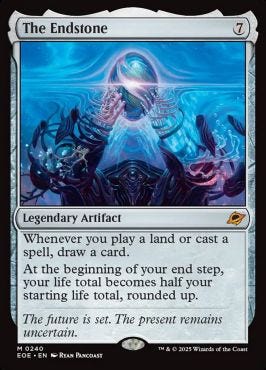
The Endstone (+)
I rated it highly but it belongs in the set’s top tier. I may have worried too much about the “if it dies” line, yet in testing it performed strongly as I remember an opponent with it out while I could only deal about six to seven damage a turn, but never the full ten. It’s a serviceable Tinker target but one that requires follow‑up action, but that’s rarely difficult in cube since it snowballs nicely, although it’s not uncommon to get decked with this.
2025 taught me how floor-based analysis can result in some myopic analyses where the assumption of “well, this just dies to removal” can result in some reductive thinking and dismissal of cards like The Endstone, which don’t always just die to removal and pose the question of “What if it doesn’t just die to removal?”
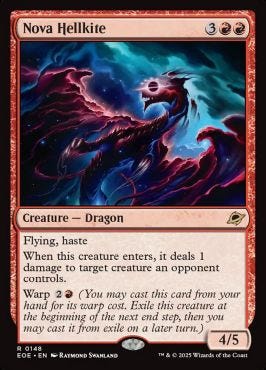
Nova Hellkite (+)
I’ve come to think this might be the best five‑mana red dragon for cube. It plays like a Flames of the Blood Hand that can be “flashed back” into a permanent dragon, often representing a huge burst of damage for the cost of a card. Its ETB didn’t often kill something, but it was nice when that achievement could be unlocked, especially against green decks to incidentally kill a mana dork. It can’t punch through large creatures like Glorybringer, so it’s primarily an aggressive tool, but I found that it works well in that role.
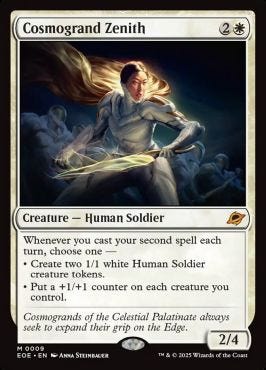
Cosmogrand Zenith (+)
It’s not Cori-Steel Cutter, but it’s a very strong three‑drop white creature, since its trigger is easy to chain, and hitting it twice is a major swing as both modes complement each other. Usually, it plays like a mini‑planeswalker, buffing your board while also being a solid creature.
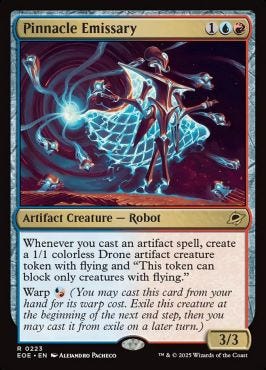
Pinnacle Emissary (-)
I still think this card is fine in artifact‑heavy decks, but its floor is very low in lists without a critical mass of artifacts, which relegates it to a parasitic artifact‑matters role. It often loses out to more broadly useful Izzet cards like Third Path Iconoclast, though it has the highest ceiling when warped into play and can generate multiple 0‑mana artifacts.
Edge of Eternity cards that I’d previously not discussed:
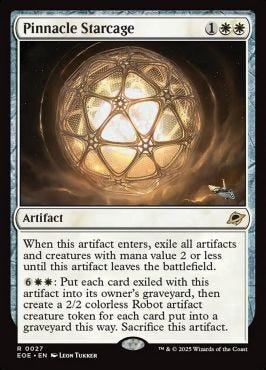
Pinnacle Starcage
This mostly plays the same role as Temporary Lockdown but with a very expensive buy‑out clause to pop it for robots if needed. It’s essentially a second Lockdown, making robots costs eight mana—and it doesn’t enable synergies that Lockdown does, like Stormchaser’s Talent, Sheltered by Ghosts and Swift Reconfiguation, so it’s more of a card to supplement Lockdown than act as a straight upgrade.
Marvel’s Spider Man / Through the Omenpaths 1:
For comparison, the original Marvel’s Spider Man / Through the Omenpaths 1 article and how ratings shifted:
Multiversal Passage: Power 5
Lady Octopus, Inspired Inventor / Merata, Neuron Hacker: 2-4.5 (-)
Spectacular Spider-Man / Ademi of the Silkchutes: Power 4.5
Spider-Woman, Stunning Savior / Makdee and Itla, Skysnarers: Power 4.5
Scarlet Spider, Ben Reilly / Borys, the Spider Rider: Power 3-4.5
Origin of Spider-Man / A Most Helpful Weaver: Power 4.25
Heroes’ Hangout / Fire-Brained Scheme: Power 4.25
Gwen Stacy / Nia, Skysail Storyteller: Power 4.25
Norman Osborn / Goben, Gene-Splice Savant: Power 4 (+)
Sandman, Shifting Scoundrel / The Scouring Stormsoul: 4
Carnage, Crimson Chaos / Desecrex, Gift of Servitude: 4
Miles Morales / Cren, Undercity Dreamer: 4
Iron Spider, Stark Upgrade / Fizik, Etherium Mechanic: 2.5-3.5 (-)
Hobgoblin, Mantled Marauder: Power 3-4
Rocket-Powered Goblin Glider / Stitcher’s Wings: Power 2-4
Arachne, Psionic Weaver / Yera and Oski, Weaver and Guide: Power 3.5
Hydro-Man, Fluid Felon / Belion, the Parched: Power 3.5
Morlun, Devourer of Spiders / Luis, Pompous Pillager: 3.5
Superior Spider-Man / Kavaero, Mind-Bitten: 3.5
Ultimate Green Goblin / Ruzic, Booed but Victorious: 3.5
Peter Parker’s Camera / Phenomena Recorder: 3.5
Hide on the Ceiling / Spectral Restitching: 3
Jackal, Genius Geneticist / Druneth, Reviver of the Hive: Power 3
Spider-Man / Through the Omenpaths 1 cards that I’d previously discussed:
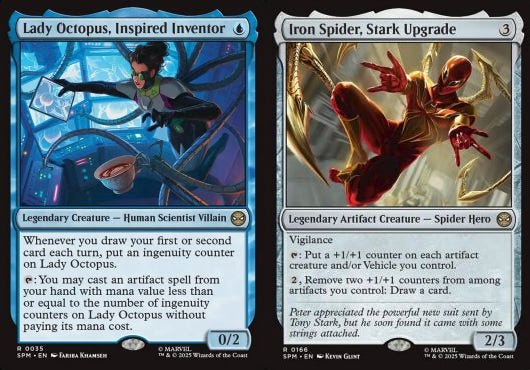
Lady Octopus, Inspired Inventor, Iron Spider, Stark Upgrade (-)
I’ve included both because I’ve lowered their floors, as without a critical mass of artifacts and artifact creatures they’re pretty middling. I don’t expect many incidental artifact creatures to appear in 2026 outside of sets like Star Trek, so I don’t see their playability rising much in the near term. Their ceilings remain strong, though: when a deck can boost or cast a few things with them, they often punch well above their weight class.
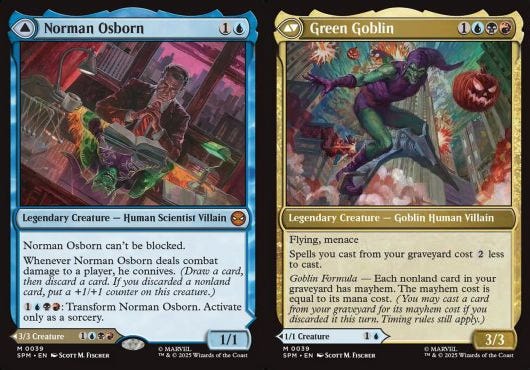
Norman Osborn (+)
I’ve bumped my rating after finding it functions well as a looter that grows over the course of a game, which testing supported. It didn’t flip frequently, and losing the looter ability on flip can make the transformed side feel less like an upgrade, but it’s been reliable in blue decks. I haven’t seen it in two‑color lists that splash a flip via rainbow lands like Starting Town, though that isn’t a major part of the card’s equation.
Spider-Man / Through the Omenpaths 1 cards that I’d previously not discussed:
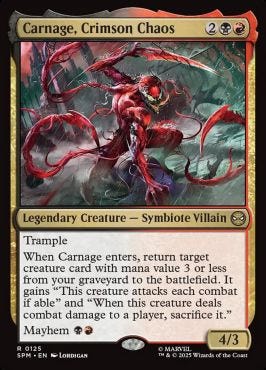
Carnage, Crimson Chaos
This card showed up in the recent MTGO Vintage Cube update as a red payoff for discard strategies. I initially worried it would be too narrow, as something only for a specific archetype while most Rakdos cards are broader value pieces, but Carnage has a high ceiling: it can generate 6+ mana for a 2‑mana investment. Even when cast fairly for four mana it usually performs well, so its upside makes it a good payoff for self-discard.
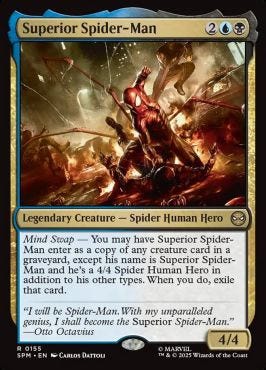
Superior Spider-Man
This was another multicolor card that I didn’t feel was “needed” by virtue of cheaper cards, but it’s another card that’s been performing well in cubes where I’ve seen it as a mid-level reanimation effect that has the upside of turning random value beaters or enablers like Norman Osborn into 4/4s.
Much like Lazotep Quarry, but with the upside of cheating a meaningful target into play. Being a creature adds value, as cards that care about creatures can leverage it, and even when it puts something like Atraxa or Vaultborn Tyrant into play as a 4/4, it usually gets the job done anyway by getting a ton of value for a bargain cost.
Avatar: The Last Airbender:

For comparison, the original Avatar: The Last Airbender article:
Wan Shi Tong, Librarian: Power 4.5
Badgermole Cub: Power 4.5
Aang, Swift Savior: Power 4.5
Fire Nation Occupation: Power 4.25
Appa, Steadfast Guardian: 4 (+)
Redirect Lightning: Power 4-4.5
Abandoned Air Temple:Power 4
Earthbender Ascension: Power 4
Wan Shi Tong, All-Knowing: Power 4
Raven Eagle: 3.75
Avatar’s Wrath: 3.75
Ba Sing Se: Power 3.75 (-)
Boomerang Basics: 2.5-3.5
United Front: 3.5
Agna Qel’a: 3.5
The Legend of Kuruk: 3.5
It’ll Quench Ya!: 2-3.5
Professor Zei, Anthropologist and Sokka, Bold Boomeranger: 3
Firebending Student: Power 2.5 (-)
Avatar cards that I’d previously discussed:
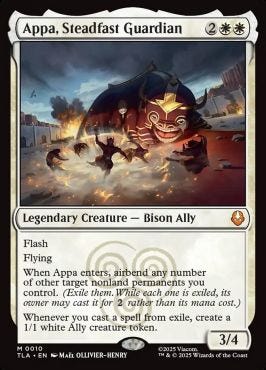
Appa, Steadfast Guardian (+)
This functioned better than a vanilla Restoration Angel since it can proactively protect or recycle permanents like planeswalkers, and the ally text isn’t flavor text either (but certainly more a minor than a major part of the card’s role.) I didn’t see it paired with adventures, but it played very well with Avatar’s instant‑speed payoffs, making it a strong inclusion for lists that want flexible, instant‑speed interaction.
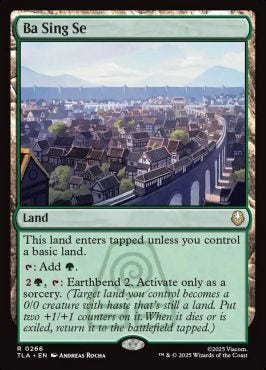
Ba Sing Se (-)
For the most part it performed as expected, but I downgraded it because requiring you to spend the mana on your turn made it awkward in decks that want to simply curve out, so it didn’t grind as many games and didn’t recycle self-sacrificing lands as often as I’d hoped. It’s still a solid land, but Abandoned Air Temple is the clear winner in that cycle.
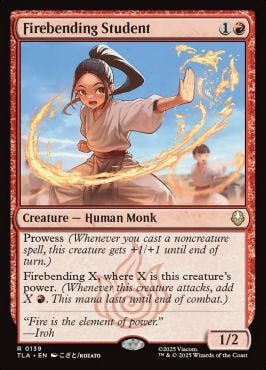
Firebending Student (-)
I expected it to be either busted or mid since mana‑cheat effects often have the potential to be broken. Vivi was an unusual Standard‑legal anomaly and this one performed closer to mid than busted. It rarely did anything broken; sometimes it let you cast an instant‑speed burn spell in combat, other times it simply attacked like a Maritime Guard with prowess.
Avatar cards that I’d previously not discussed:
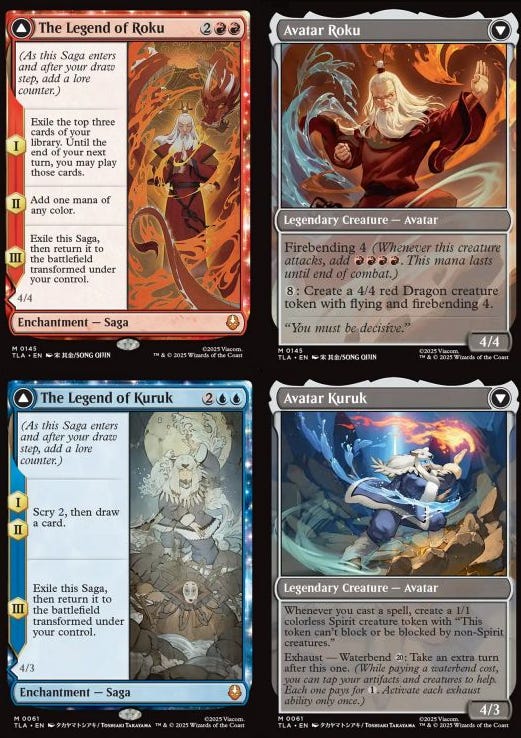
The Legend of Roku, The Legend of Kuruk
I initially dismissed these as too slow, especially with Legend of Roku inviting comparisons to Showdown of the Skalds, but I underestimated how real their backsides are. Like Fable of the Mirror Breaker, they can’t attack once flipped, yet their transformed sides are decently-sized 4-power threats that initial impressions didn’t fully account for.
A recent LSV video compared Legend of Kuruk to Jace: The Mind Sculptor, which is a useful way to show how they play the long game, though I think Kuruk is the weaker of the two, as its backside and chapters feel noticeably worse than Roku’s. That and it’s also just a harder sell to play a main phase sorcery speed card for 4 mana in blue than in red, but the potential’s great as at least LSV said it’s been performing nicely.
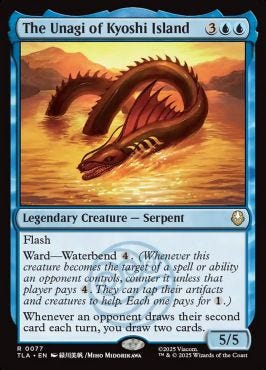
The Unagi of Kyoshi Island
This was one of Avatar’s stronger five‑drops that I mentioned earlier, as flash gives it instant‑speed utility by letting you cast it in response to an opponent drawing multiple cards. Even on its own, a hard‑to‑kill 5/5 with a meaningful ward is excellent at ambushing blockers. A nice extra: if an opponent must tap permanents to pay the waterbending cost, you can remove those permanents and make the ward fizzle, turning the interaction into additional value.
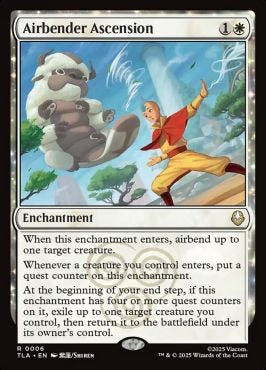
Airbender Ascension
This pleasantly surprised me in testing, though I skipped writing about it for space reasons. It pairs exceptionally well with token generators, and it’s even better when it’s a creature because that helps it reach its ultimate more reliably. I haven’t seen it go crazy go nuts yet, but the potential is definitely there.
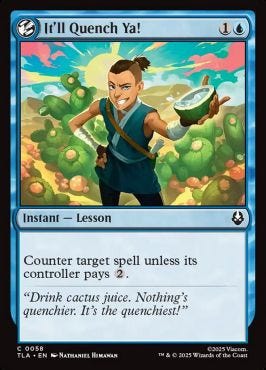
It’ll Quench Ya!
The floor of Quench is fine, but I talked in another post about my thoughts on including Learn and Lesson cards in more detail here.
Miscellaneous
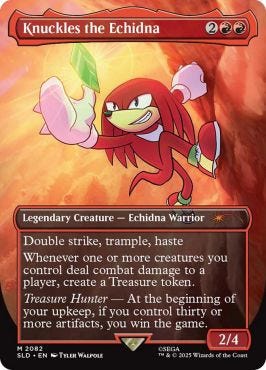
Knuckles the Echidna: 4.5
When Knuckles was previewed, many compared it to Rampaging Raptor, but after playing it I find Knuckles clearly superior. It almost always generates at least one Treasure, often two, because it creates a Treasure whenever any creature connects, not just itself. It’s also useful for paying off‑color costs, like the tri‑color transform requirements on Spider‑Man’s transforming MDFCs, which came up in Spider-Man testing with cards like Gwen Stacy. The incidental artifacts can help artifact‑synergy cards, though that interaction was rare in my games. The alternate win condition never came up as 30 artifacts is a huge ask and that’s just additive distraction, anyway.
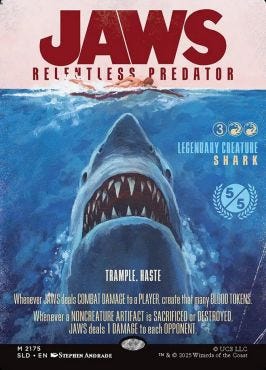
Jaws, Relentless Predator: 4
Jaws has been pretty good as a dragon-style finisher that trades flying for trample, which is worse for ending games but when its saboteur trigger connects, it usually means you just draw gas. It hasn’t seen a lot of play yet but like Knuckles, it usually creates a ton of artifacts and being one of the fastest sources of damage from a 5-drop has been nice. I’m wishy-washy on if I like it more than Nova Hellkite, but having no option to run it out for 2R is a knock against Jaws. I haven’t seen it combined with other blood or artifact-caring cards, but like with Bloodtithe Harvester, it doesn’t require extra blood to work in cube.
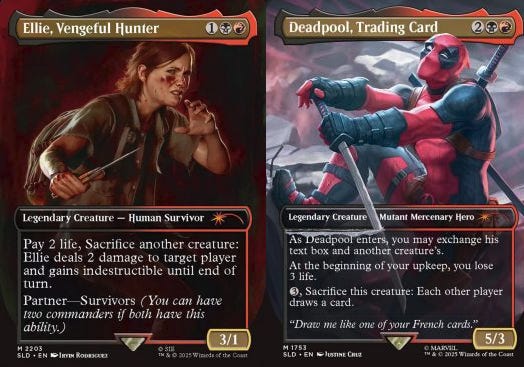
Ellie, Vengeful Hunter, Deadpool, Trading Card: 3.5
Both of these B/R cards fill a similar role as fast closers. Ellie isn’t limited to once‑per‑turn activations or tied to mana, so when you’re at parity and ahead on life she can end games very quickly. Deadpool excels at disrupting opponents’ threats and reads more like a removal spell that leaves you with a 5/3, where you think of it as a Gilded Drake riff instead of a creature to always play on-curve.
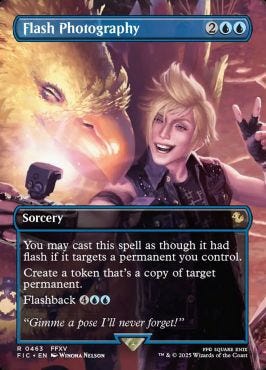
Flash Photography: 3
Most clone effects aren’t great at four mana, as Phyrexian Metamorph often gets there by being a 3-drop, but I like that this one can target an opponent’s permanents.
Flashback ain’t flavor text either, even if neither side is that efficient, since being able to copy one of your own things at EOT is a nice upside that we haven’t seen on a clone outside of ones that never really did much (Malleable Impostor, Stunt Double, Waxen Shapethief.)
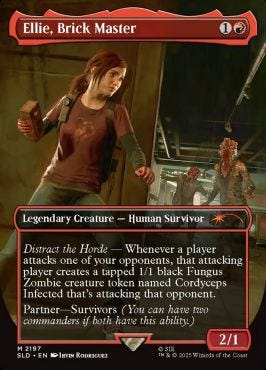
Ellie, Brick Master: 2.5
Speaking of Ellie, I wanted to briefly talk about her 2-mana card; it reminded me of Searslicer Goblin, a card that I wasn’t too hyped for in Foundations and this is similar where it’s great if the coast is clear, but having 1/1s, even if they get to attack for free, don’t tend to do much. I felt the same for Ainok Strike Leader as cards that suffer in an era of better-developed boards than in years’ past.
Thanks for reading. I’m looking forward to what 2026 is going to bring for cube if 2025 is any sign of how the year will be. You can find my socials and my cube lists on my Linktree, as well as other cube set review articles and design articles that I’ve written over the last 15 years!